
CRIR-JRH Scientific Conference – December 3, 2025 | Dr. Leila Ali, Neurologist : How haptic feedback modulates sensory working memory and emotional engagement during anatomy learning in mixed reality (MR)
Some pages published before that date may still contain the former CISSS and CIUSSS designations.
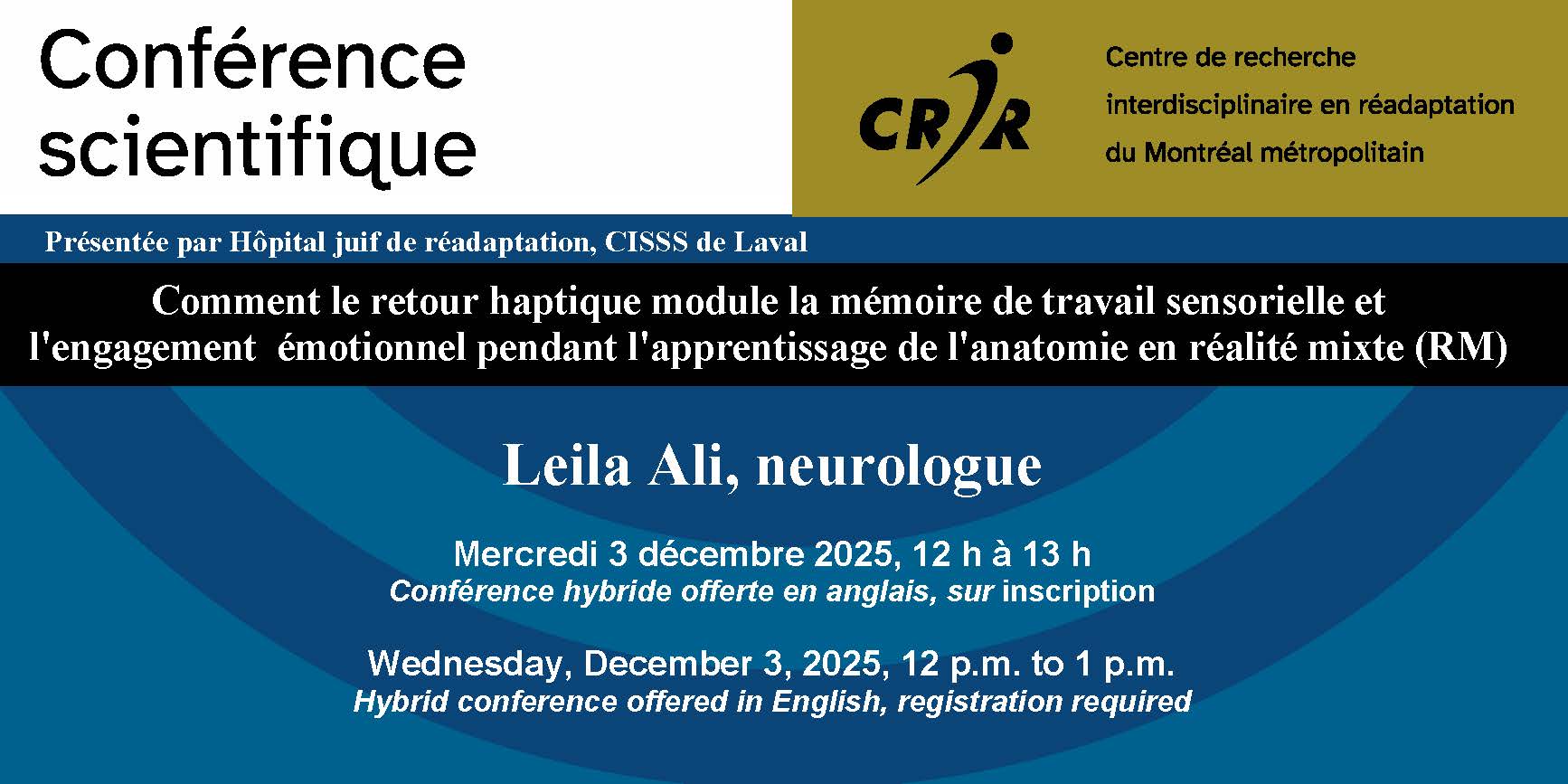
When: 3 December 2025 12:00 to 3 December 2025 13:00
Where:
Conference offered in English, in hybrid mode, upon registration:
◼️ In person: Jewish Rehabilitation Hospital, Room D 1004
Please confirm your presence: Mireia.Carrillo.cissslav@ssss.gouv.qc.ca
or
◼️ Virtual: On Zoom. Please register: : https://us02web.zoom.us/meeting/register/72YSBm9jRBO2NOqmIpX-tw
Scientific conference presented by the CRIR-Jewish Rehabilitation Hospital (JRH), CISSS de Laval as part of the HJR’S “Talking Research” Series.
Presentations by researchers or postdoctoral fellows or clinicians on the findings of their research projects.


How haptic feedback modulates sensory working memory and emotional engagement during anatomy learning in mixed reality (MR)
- Wednesday, December 3, 2025 | 12 p.m. to 1 p.m.
- Conference offered in English, in hybrid mode, registration required
- View the poster (PDF format) via this link: How haptic feedback modulates sensory working memory and emotional engagement during anatomy learning in mixed reality (MR).
REGISTRATION REQUIRED via this link: Register here Ce lien s’ouvrira dans une nouvelle fenêtre”Ce lien s’ouvrira dans une nouvelle fenêtre »
Se lien s’ouvrira dans une nouvelle fenêtre »
Ce lien s’ouvrira dans une nouvelle fenêtre”(pdf(pd(pdf
(pdf)(docx)(docx)
Ce lien s’ouvrira dans une nouvelle
Speaker

Dr. Leila Ali, Neurologist
PhD Student at University of Camerino
PhD research trainee at McGill University Sensorimotor Control Lab
Ce lien s’ouvrira dans une nouvelle fenêt
Dr. Leila Ali is a neurologist, cognitive remediation therapist, and a PhD student in theoretical and applied neuroscience affiliated with the Universities of Camerino, and Pegaso.
Her work explores the intersection of neuroscience, neurotechnology, and education, with a focus on immersive digital environments’ role in motor and haptic learning, emotions and cognition.
Conference : « How haptic feedback modulates sensory working memory and emotional engagement during anatomy learning in mixed reality (MR) »
Haptic feedback has the potential to enhance anatomy training in mixed reality (MR) by engaging multisensory working memory systems and strengthening emotional involvement in learning. This study investigates how tactile cues during manipulation of anatomical structures influence short-term sensory memory encoding (visual, auditory, and tactile), and affective engagement. Using MR brain anatomy tasks, we compare learning outcomes and emotional responses between haptic interaction conditions with and without realistic tactile input. Findings will advance understanding of how touch-based interactions shape cognitive-emotional processing in immersive anatomy education, informing future multisensory design principles for medical training environments.
Question and registration to attend: Mireia.Carrillo.cissslav@ssss.gouv.qc.ca